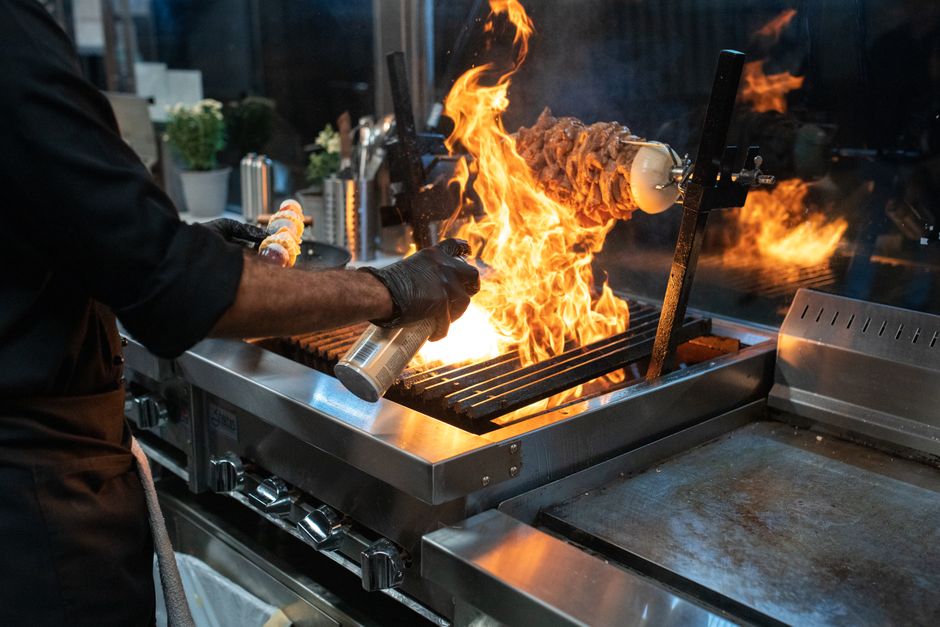
Motor and Drive System Failures
The spit motor assembly fails more than any other component in gas and electric rotisseries. I've replaced hundreds of these across Hickory 500, Alto-Shaam AR-7E, and Rotisol Grand Flame units.
Most common failure is the gear motor itself. On Hickory units, you're looking at part number HIC-4220-000 for the 120V 4RPM motor assembly. Costs around $340 to $420 depending on supplier. The motor binds internally due to grease breakdown after about 18,000 hours of runtime. You'll smell it before it quits completely, a burnt gear oil odor.
Second issue is the drive chain or belt. Rotisol uses a #25 roller chain that stretches over time. When chain pitch elongates more than 3%, the spit rods start jerking during rotation. Measure with the motor off: if you can pull the chain more than half an inch away from the sprocket at mid-span, replace it. Chain kit part RC-140 runs about $85.
Third problem is the shaft coupler between motor and first spit rod. These are usually a square socket design, 5/8 inch on most commercial units. The socket wears oval from years of start-stop cycles. Check this by trying to rotate the spit rod by hand with motor engaged. If you feel more than 1/8 inch of play before it catches, the coupler is shot. Don't try bandaid fixes with shims. Replace the coupler, usually $45 to $75.
When to call a tech: If the motor hums but won't turn even with spits removed, you likely have a capacitor or winding failure. These require proper electrical testing and motor replacement. Not a DIY job unless you have a multimeter and know how to read motor nameplate data.
I've also seen bearing failures on the spit rod pillow blocks. Listen for grinding noise that changes pitch as the spit rotates. The sealed bearings (typically 6204-2RS or similar) can be replaced individually on most brands. Pack of four runs about $60. You'll need to pull the entire spit assembly out, which means coordinating with kitchen staff during downtime.
Ignition and Burner Problems
Gas rotisserie ovens use either standing pilot or electronic ignition. Electronic ignition has been standard since about 2008 on new equipment, and that's where I see the most service calls today.
The spark module fails frequently on Alto-Shaam and Hickory models. You'll get error code E.02 or IGN FAIL on the controller. Before replacing the $280 ignition module, check three things first: spark electrode gap should be 1/8 inch, electrode ceramic must not be cracked, and the ground path must be clean metal-to-metal contact.
I carry a spare spark electrode on every call. Part numbers vary but most are universal 3/8-24 thread mount. Around $35. The electrode wire insulation cracks from heat cycles, causing weak spark or intermittent ignition. If you see any brown discoloration on the white ceramic, replace it.
Burner orifice clogging happens in areas with hard water or coastal salt air. The brass orifice develops corrosion or gets carbon buildup. Manifold pressure should be 3.5 inches water column for natural gas, 10 inches for LP. Check this with a manometer at the pressure tap. If pressure is correct but flame pattern is weak or yellow-tipped, pull the orifices and inspect. I use a #78 drill bit for natural gas orifices on most standard burners, but verify your burner rating first. Wrong orifice size creates carbon monoxide risk.
Flame sensors fail gradually. The flame rod (flame rectification design) or thermocouple develops a weak signal. On systems with electronic controls, you'll see the burner light then shut down after 3 to 7 seconds. Measure microamp signal at the valve. Should read 2.5 to 8 microamps depending on brand. Below 2 microamps, replace the sensor. Most are $40 to $70 parts.
| Symptom | Likely Cause | Part Cost | Labor Time |
|---|---|---|---|
| Sparks but won't light | Gas valve or orifice | $180-$340 | 1.5 hrs |
| Lights then shuts off | Flame sensor | $40-$70 | 0.5 hrs |
| No spark at all | Ignition module | $240-$320 | 1 hr |
| Yellow lazy flame | Orifice or air shutter | $15-$45 | 0.5 hrs |
Temperature Control Issues
Temperature control problems show up as uneven cooking, temperature swings, or failure to reach setpoint. The controller brain itself rarely fails. It's usually the sensors or the relay outputs.
Thermocouple sensors drift out of calibration. Most rotisseries use Type K thermocouples with a standard mini-connector. After about 30,000 hours of exposure to 350°F to 450°F environments, the junction degrades. Test this with a calibrated reference thermometer. If your oven displays 375°F but an independent probe reads 340°F or 410°F, suspect sensor drift.
I replace thermocouples in pairs when possible. They age at similar rates. Generic Type K thermocouples work fine on most brands, around $28 each. Make sure the probe length matches original. On Hickory 500 models, you need the 6-inch probe to reach proper position in the cook chamber. Too short and you're reading radiant heat off the burner shield, not actual air temperature.
SSR (solid state relay) failure causes temperature runaway or failure to heat. The relay switches power to heating elements or modulates gas valves. When they fail, they usually fail closed, meaning continuous heat. This is dangerous. I've seen units climb to 650°F with display still showing 375°F setpoint because the controller lost output control.
Test the SSR with the oven cold. Remove one leg of the load side and measure resistance. Should be infinite ohms with control signal off, near zero with signal on. If you read continuity with no control signal, the SSR is failed closed. Replace immediately. Fotek or Crydom SSRs in the 25 to 40 amp range run $65 to $145 depending on spec.
When to call a tech: Controller programming and calibration requires manufacturer-specific software and procedures. If you've replaced sensors and relays but still have control issues, the controller needs proper diagnostics. Some brands require proprietary USB interfaces for parameter adjustment.
High limit safeties trip for a reason. I find operators jump these out or reset them without finding root cause. The manual reset high limit (usually a 3/4-inch diameter disc switch mounted on the chamber ceiling) should never trip during normal operation. If it does, you have runaway heat from a failed relay or controller. Fix the problem, don't just reset the switch.
Door Seal and Heat Retention
Door seals seem simple but cause real efficiency and performance problems when worn. I can spot a bad seal from ten feet away by watching the shimmer of escaping heat around the door perimeter.
Most rotisseries use fiberglass rope gasket or high-temp silicone bulb seal. The rope gasket hardens and shrinks with age. After three to four years in a busy operation, the gasket compresses to about 60% of original thickness. Heat pours out, recovery time doubles, and gas consumption climbs 20 to 30 percent.
Replace rope gasket every three years as preventive maintenance. Costs $40 to $85 for a full door kit depending on oven size. Use the right adhesive. High-temp silicone rated to 500°F minimum. The gasket seats in a channel on most brands, but some older Hickory models use a flat mounting that requires careful bead placement.
Door alignment matters as much as gasket condition. Hinges wear and doors sag. Check alignment by placing a dollar bill between door and frame, close the door, then try to pull the bill out. Do this at six points around the perimeter. If the bill slides out easily at any point, the door needs adjustment or the hinge pins are worn.
Hinge pin replacement is straightforward on most units. The pins are 3/8 or 1/2 inch diameter stainless dowels with retaining clips. When worn, the door drops 1/4 inch or more. New hinge pin sets run about $55. Takes 45 minutes to swap them including door removal.
Glass panels crack from thermal shock or impact. Double-pane tempered glass is standard, about $180 to $340 to replace depending on size. The inner pane cracks more often than outer because it sees higher temperature swings. If you notice condensation between panes, the seal is broken and efficiency is shot. Replace the entire glass assembly, not just the cracked pane.
Electrical and Safety Circuit Faults
Electrical problems on rotisserie ovens kill service calls dead until resolved. The safety interlocks are there for good reason, mostly to prevent operating with door open or motor jammed.
Door interlock switches fail frequently from grease contamination. These are usually micro-switches with a lever actuator mounted near the door latch. When the switch contacts get gummed up, you'll get intermittent operation or no operation at all. Error code varies by brand but look for E.08, DOOR, or INTERLOCK on the display.
Clean the switch first before replacing. Pull the switch, spray with electrical contact cleaner, and cycle it 20 or 30 times. If that doesn't restore proper operation, replace it. Standard micro-switches run $12 to $25. Make sure replacement is rated for the current, usually 10 or 15 amps at 120V.
Contactor coils burn out from voltage sags or end-of-life. The main contactor controls power to heating elements on electric rotisseries. When the coil fails, you'll hear no click when the controller calls for heat. Measure coil resistance. Should match nameplate spec, usually 40 to 200 ohms depending on voltage. If it reads open or significantly high, replace the contactor. A 30 to 40 amp contactor costs $85 to $145.
Contact pitting on the contactor causes arcing and eventual welding. Inspect the contacts annually. If you see carbon buildup or pitting deeper than 1/32 inch, replace the contactor even if it's still working. Welded contacts mean runaway heat with no control. That's a fire hazard.
I've traced dozens of nuisance trips on 208V three-phase units to voltage imbalance. If one leg reads more than 2% different from the others, you'll get erratic operation and premature component failure. This is a facility electrical problem, not an oven problem. Document the voltages and inform the facility manager. They need an electrician to check the transformer and panel.
Ground faults show up as breaker trips, usually GFCI or AFCI breakers. On electric rotisseries, the heating elements can develop pinhole leaks in the sheath, allowing current to leak to ground. Measure insulation resistance from element to ground with a megohmmeter. Should read above 10 megohms. Below 1 megohm indicates element failure. Elements range from $120 to $280 each depending on wattage and length.
Preventive Maintenance That Actually Matters
Preventive maintenance prevents most of what I've described above. But I see operators either skip it entirely or waste time on tasks that don't matter.
Every week: Clean the spit rods and forks. Grease and carbon buildup adds weight and throws the assembly out of balance. This accelerates motor and bearing wear. Use hot degreaser and a stiff brush. Takes 15 minutes.
Every month: Check chain or belt tension. Proper tension is about 1/4 inch deflection at mid-span with light finger pressure. Too loose causes jerky rotation and sprocket wear. Too tight overloads the motor bearings. Adjust the motor mount position to tension correctly.
Every quarter: Pull and inspect all burner components on gas units. Look for carbon buildup on orifices, cracks in the burner venturi, and corrosion on flame sensors. Clean everything with a wire brush and compressed air. This takes about an hour but prevents most ignition and combustion failures.
Every six months: Check door alignment and gasket condition as described earlier. Calibrate temperature control against a reference thermometer. Most controllers have a calibration offset parameter you can adjust plus or minus 25°F. If you need more offset than that, replace the sensor.
Annually: Full electrical inspection. Measure voltage at all power points. Inspect all wire terminations for tightness and discoloration. Check contactor contacts for pitting. Megger test all heating elements. Inspect and grease all motor bearings if they have grease fittings.
I tell every operator the same thing: An hour a month of real maintenance prevents four hours of emergency breakdown repair at the worst possible time. The oven doesn't care if you're slammed on a Saturday night.
Keep a service log. Write down what you did and when. Note any unusual observations like strange noises, temperature drift, or slow motor startup. These early warnings let you schedule repairs during slow periods instead of having a dead oven at Friday dinner rush.
Stock critical spares if you're running high-volume operations. A spare spit motor, ignition module, door gasket kit, and thermocouple pair costs under $800 and covers the most common failures. Keeps you running while parts are on order for the permanent fix.
For detailed rotisserie oven service or if diagnostics point to component-level repairs beyond your capability, reach out to technicians who've seen these failures hundreds of times. Superior Service has been handling commercial oven repair across California since 1980. We know these machines inside and out.